Rwanda Gorilla Trekking Photography Tips 2026
Photographing mountain gorillas in Volcanoes National Park is uniquely challenging. The bamboo and Hagenia forest creates broken, low-contrast light. The gorillas move unpredictably and sit in dense vegetation. Flash is strictly prohibited (it disturbs the gorillas and can harm young gorillas' developing eyesight). And you have exactly 60 minutes with the family — a combination of time pressure and technical challenge that catches most photographers off guard.
These are the photography lessons learned from guiding hundreds of clients through Volcanoes National Park since 2014.
The No-Flash Rule — Understanding Why and How to Work Around It
Rwanda Development Board (RDB) prohibits all flash photography in gorilla habitat — built-in camera flash, speedlights, and ring lights. This is non-negotiable and enforced by the park trackers who will ask you to disable flash before you enter the gorilla zone. Violations result in permit revocation with no refund.
Working without flash in the Virunga forest means you need to rely on your camera's sensor performance at high ISO settings and on the available natural light — which, on overcast mornings (common in the cloud forest), is genuinely dim. This is not insurmountable but requires preparation:
- Set your camera to a high ISO (1600–6400) the night before and test your camera's noise performance at that setting
- Understand your lens's maximum aperture and use it wide open (f/2.8 or f/4 is typical for zoom lenses in this range)
- Shoot in burst mode — the gorillas move, and burst gives you the best chance of a sharp frame in each sequence
- Shoot RAW format so you can recover shadow detail and reduce noise in post-processing
Best Camera Gear for Gorilla Trekking Rwanda
Mirrorless Cameras (Best Choice)
Modern mirrorless cameras (Sony A7 series, Nikon Z series, Canon EOS R series) handle high-ISO performance better than DSLRs in the same price tier. The Sony A7 IV, Sony A7R V, and Nikon Z8 are excellent choices — their sensors maintain clean images at ISO 3200–6400, which is what you will be shooting in forest light. Mirrorless cameras are also lighter than equivalent DSLRs, which matters on a gorilla trek where you may be climbing for 1-5 hours.
DSLR Cameras
A DSLR like the Canon 5D Mark IV, Nikon D850, or Nikon D6 performs well in the gorilla forest if it has good high-ISO characteristics. If you already own a full-frame DSLR, bring it — it will get excellent results. Crop-sensor DSLRs lose a stop of light at the same ISO and produce noisier images in low forest light.
Smartphones
iPhone 15 Pro, Samsung Galaxy S25 Ultra, and Pixel 9 Pro all have excellent low-light performance and produce outstanding environmental shots and face portraits of gorillas at close range. The limitation is zoom reach — at 7-metre minimum distance from a silverback, a smartphone gives you a decent close-up of a gorilla face in good light but will struggle with gorillas that are 15-20 metres away in vegetation. The smartphone is an excellent secondary camera and a practical choice for travellers who do not want to manage DSLR/mirrorless equipment on trek day.
Best Lens for Gorilla Trekking
70-200mm f/2.8
The ideal gorilla trekking lens. At 200mm you get excellent frame-filling shots of faces at 7-metre minimum distance. The f/2.8 maximum aperture gathers more light than the f/4 or f/5.6 alternatives, which matters critically in forest light. The f/2.8 versions of this lens (Sony G Master, Nikon S-line, Canon L) are heavy but worth it for the image quality.
100-400mm or 150-600mm
If gorillas are further away (up a slope, partially obscured by vegetation), a longer zoom gets you closer. The Sigma 100-400mm and Tamron 100-400mm are well-priced options. The Sony 200-600mm and Nikon 180-600mm are newer additions that perform excellently. The trade-off is maximum aperture — at 400-600mm, most lenses are f/5.6 or f/6.3, losing light in the forest.
What to Avoid
- Wide-angle lenses under 35mm — you will be too far from the gorillas at minimum distance for wide angles to be useful for wildlife shots (though they work beautifully for environmental forest scenes)
- Slow zoom lenses (f/6.3 at all focal lengths) — in dark forest conditions these struggle
- Drones — banned in all Rwanda national parks without a specific RURA permit
Camera Settings for Gorilla Trekking
Set these the night before so you are ready on trek day:
- Mode: Aperture Priority (Av/A) — set your aperture wide open (lowest f-number), let the camera choose shutter speed
- ISO: Auto, minimum ISO 800, maximum ISO 6400 — allow Auto ISO to adjust automatically as forest light changes
- Minimum shutter speed: 1/125s (set in Auto ISO menu) — gorillas move, and anything below 1/125s risks motion blur
- Autofocus: Continuous (AI Servo/AFC) with face/eye detection if available — modern mirrorless cameras with gorilla face tracking are genuinely excellent
- Drive mode: High burst (8-20fps)
- Format: RAW (or RAW+JPEG)
- Flash: Disabled — do this before the trek briefing, not after
Shot Composition Tips from the Gorilla Forest
- The silverback portrait — most trekkers rush to capture the silverback. Get close but also step back to show him in his environment. A silverback sitting in bamboo with light filtering through is more powerful than a tight head shot alone.
- Infants with mothers — baby gorillas in their first 3 years are curious, playful, and often approach closer than the 7-metre minimum before a tracker redirects them. These are your best intimate shots. Be ready.
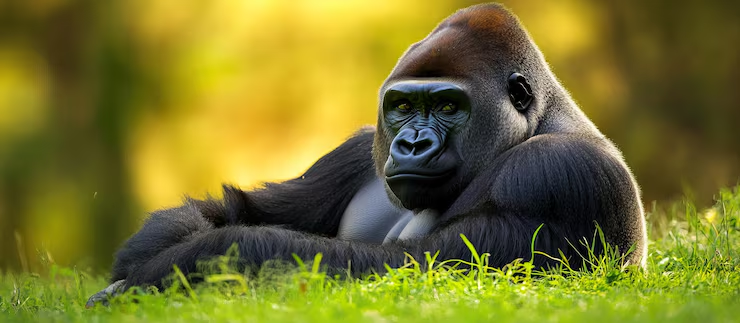
- Eye contact — gorilla eyes have genuine depth. Face shots at eye level (crouch if you can) with eye contact create the most emotionally powerful gorilla photographs.
- The habitat — shoot wide when gorillas allow it to show the ancient bamboo forest context. A gorilla visible but small in a vast green forest frame tells a different story than a 400mm tight shot.
For the best photographs, hire a porter at Kinigi ($15-20) so both hands are free for your camera during the gorilla hour. Rwanda SafariTours guides know the families' habitual areas and forest light patterns — our guides can position you for the best light during your gorilla hour. Book your gorilla trekking experience at +250 787 619 387.
Was this guide helpful?
Book Rwanda Gorilla Trekking or Safari?
Expert local guides since 2014. Private 4x4, RDB-certified.
Get a Free Quote WhatsApp Us Gorilla Permit Guide & Prices